

What Percentage Of Americans Are Registered As Indepedent
Story Highlights
- Preferences shifted from nine-signal Democratic advantage to v-point GOP edge
- Average party preferences for all of 2021 similar to past years
- Largest percentage of U.S. adults identify as political independents
WASHINGTON, D.C. -- On average, Americans' political party preferences in 2021 looked like to prior years, with slightly more U.S. adults identifying equally Democrats or leaning Democratic (46%) than identified every bit Republicans or leaned Republican (43%).
However, the general stability for the full-year average obscures a dramatic shift over the class of 2021, from a 9-percent-point Autonomous reward in the first quarter to a rare five-point Republican edge in the 4th quarter.
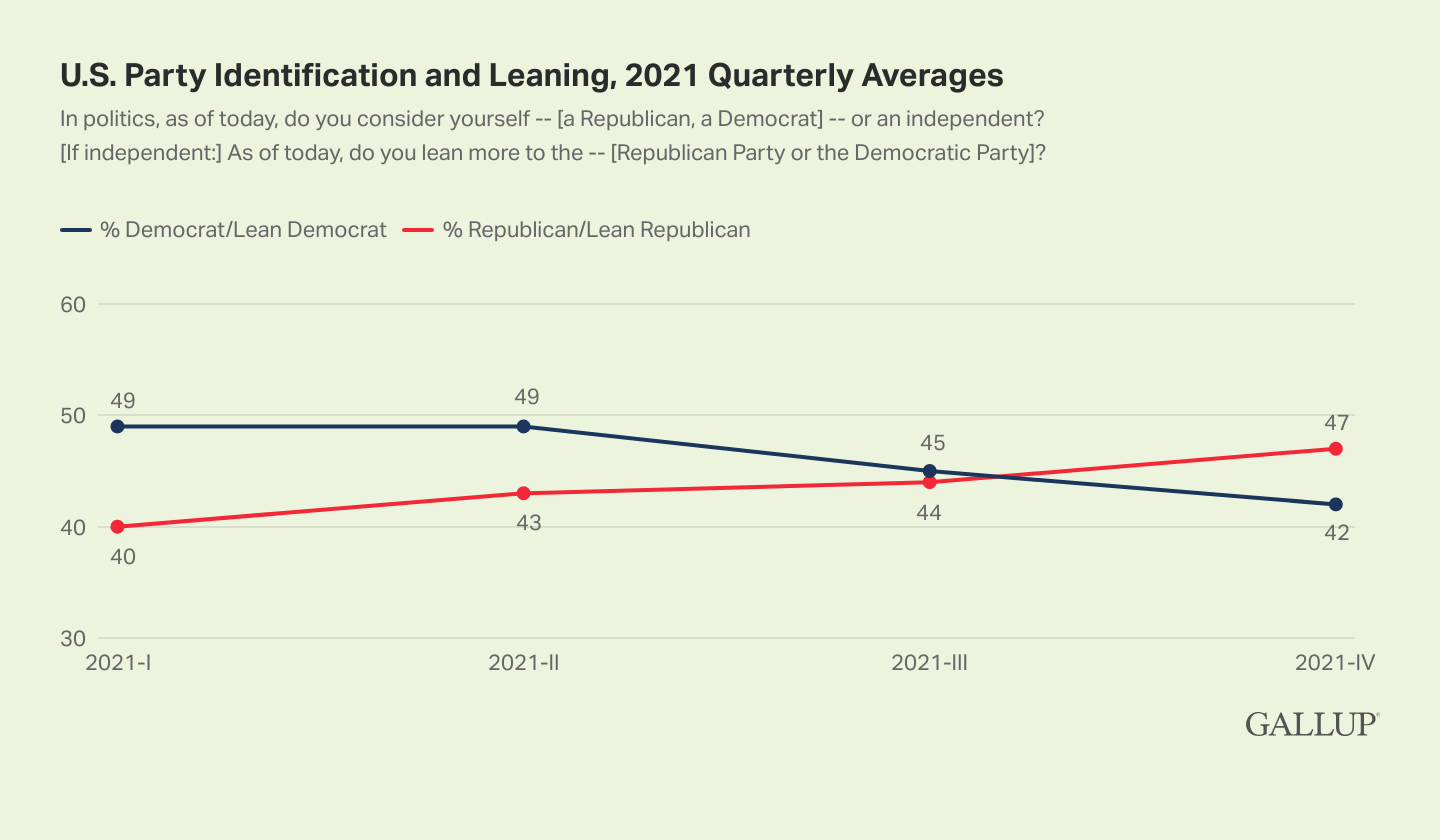
Line graph. Quarterly averages of U.S. party identification and leaning in 2021. In the beginning quarter of 2021, 49% of U.S. adults identified as Democrats or leaned Democratic, while 40% identified as Republicans or leaned Republican. In the second quarter, 49% were Democrats or Democratic leaners, and 43% were Republicans and Republican leaners. In the tertiary quarter, 45% were Democrats and Democratic leaners, and were 44% Republicans and Republican leaners. In the 4th quarter, 42% were Democrats and Democratic leaners, and 47% were Republicans and Republican leaners.
These results are based on aggregated information from all U.Southward. Gallup telephone surveys in 2021, which included interviews with more than than 12,000 randomly sampled U.S. adults.
Gallup asks all Americans information technology interviews whether they identify politically as a Republican, a Democrat or an independent. Independents are then asked whether they lean more toward the Republican or Autonomous Party. The combined percentage of party identifiers and leaners gives a mensurate of the relative forcefulness of the two parties politically.
Both the nine-bespeak Autonomous advantage in the offset quarter and the five-point Republican edge in the fourth quarter are amidst the largest Gallup has measured for each party in any quarter since it began regularly measuring party identification and leaning in 1991.
-
The Autonomous pb in the starting time quarter was the largest for the party since the fourth quarter of 2012, when Democrats too had a ix-point advantage. Democrats held larger, double-digit advantages in isolated quarters between 1992 and 1999 and nearly continuously between mid-2006 and early 2009.
-
The GOP has held every bit much equally a v-signal advantage in a full of only four quarters since 1991. The Republicans concluding held a 5-point reward in party identification and leaning in early 1995, after winning control of the House of Representatives for the get-go time since the 1950s. Republicans had a larger reward only in the first quarter of 1991, subsequently the U.S. victory in the Persian Gulf State of war led past then-President George H.W. Bush-league.
Party Preference Shifts Follow Changes in Presidential Blessing
Shifting political party preferences in 2021 are probable tied to changes in popularity of the two men who served as president during the year. Republican Donald Trump finished out his single term in January, subsequently being defeated in the 2020 election, with a 34% job blessing rating, the everyman of his term. His popularity barbarous more ten points from Ballot Day 2020 as the country'due south COVID-nineteen infections and deaths reached then-record highs, he refused to acknowledge the event of the election, and his supporters rioted at the U.S. Capitol on Jan. 6, 2021, in an attempt to preclude Congress from counting the 2020 Electoral Higher votes.
Democrat Joe Biden enjoyed relatively high ratings later on taking office on Jan. 20, and his approval stayed high through the early summer as COVID-nineteen infections dramatically decreased afterwards millions of Americans got vaccinated against the affliction. A summer surge of infections tied to the delta variant of the coronavirus made it clear the pandemic was not over in the U.Southward., and Biden'south blessing ratings began to sag. Later, the chaotic U.South. withdrawal from Transitional islamic state of afghanistan acquired Biden's ratings to fall further, into the low 40s. His ratings remain depression as the U.S. battles ascent aggrandizement and yet another surge of COVID-xix infections, tied to the omicron variant of the virus.
With Trump's approval rating at a low point and Biden relatively popular in the first quarter, 49% of Americans identified as Democrats or leaned Democratic, compared with xl% who were Republicans or Republican leaners.
In the second quarter, Democratic affiliation stayed high, while Republican affiliation began to recover, increasing to 43%.
The third quarter saw a decline in Democratic identification and leaning, from 49% to 45%, as Biden'due south ratings began to falter, while at that place was no meaningful change in Republican affiliation.
In the fourth quarter, party support flipped as Republicans made gains, from 44% to 47%, and Democratic amalgamation fell from 45% to 42%. These quaternary-quarter shifts coincided with strong GOP performances in 2021 elections, including a Republican victory in the Virginia gubernatorial election and a near-upset of the Democratic incumbent governor in New Jersey. Biden won both states past double digits in the 2020 ballot.
The GOP advantage may be starting to ease, all the same, equally Gallup's latest monthly judge, from December, showed the two parties about even -- 46% Republican/Republican leaning and 44% Democratic/Democratic leaning.
2021 Shifts Occurred Amidst Both Core Party Identifiers and Less Attached Leaners
The shifts in party affiliation in each quarter of 2021 were credible in both the percentage identifying with each party and the percentage of independents leaning to each party, merely with more changes among leaners than identifiers.
Betwixt the first and fourth quarters, the percentage of Democratic identifiers decreased by two points, while the percent of Autonomous-leaning independents dropped five points. Republican identification increased by three points from the beginning to the stop of 2021, while Republican leaners increased by iv points.
Changes in Party Identification and Leaning, by Quarter, 2021
In politics, as of today, exercise you consider yourself -- [a Republican, a Democrat] -- or an independent? // As of today, do you lean more to the -- [Democratic Party or the Republican Party]?
| 2021-I | 2021-Ii | 2021-Iii | 2021-IV | |
|---|---|---|---|---|
| % | % | % | % | |
| Democrat | 30 | 31 | 28 | 28 |
| Autonomous-leaning independent | 19 | xviii | 17 | 14 |
| Not-leaning independent | 10 | 5 | 8 | nine |
| Republican-leaning independent | 15 | 17 | xvi | xix |
| Republican | 25 | 26 | 28 | 28 |
| Percentage with no opinion not shown | ||||
| Gallup | ||||
Democrats Usually Concur an Reward, and Did So in 2021
When all the 2021 shifts are netted out, the Democrats' boilerplate three-betoken advantage for the entirety of the year is simply slightly smaller than they had in recent years. Democrats held five- or vi-bespeak advantages in party affiliation each year betwixt 2016 and 2020, and three-bespeak edges in 2014 and 2015.
Gallup began regularly measuring political party leaning in 1991, and in nigh years, significantly more Americans have identified as Democrats or as independents who lean Democratic than as Republicans or Republican leaners. The major exception was 1991, when Republicans held a 48% to 44% advantage in political party identification and leaning. From 2001 through 2003 and in 2010 and 2011, the parties had roughly equal levels of support.
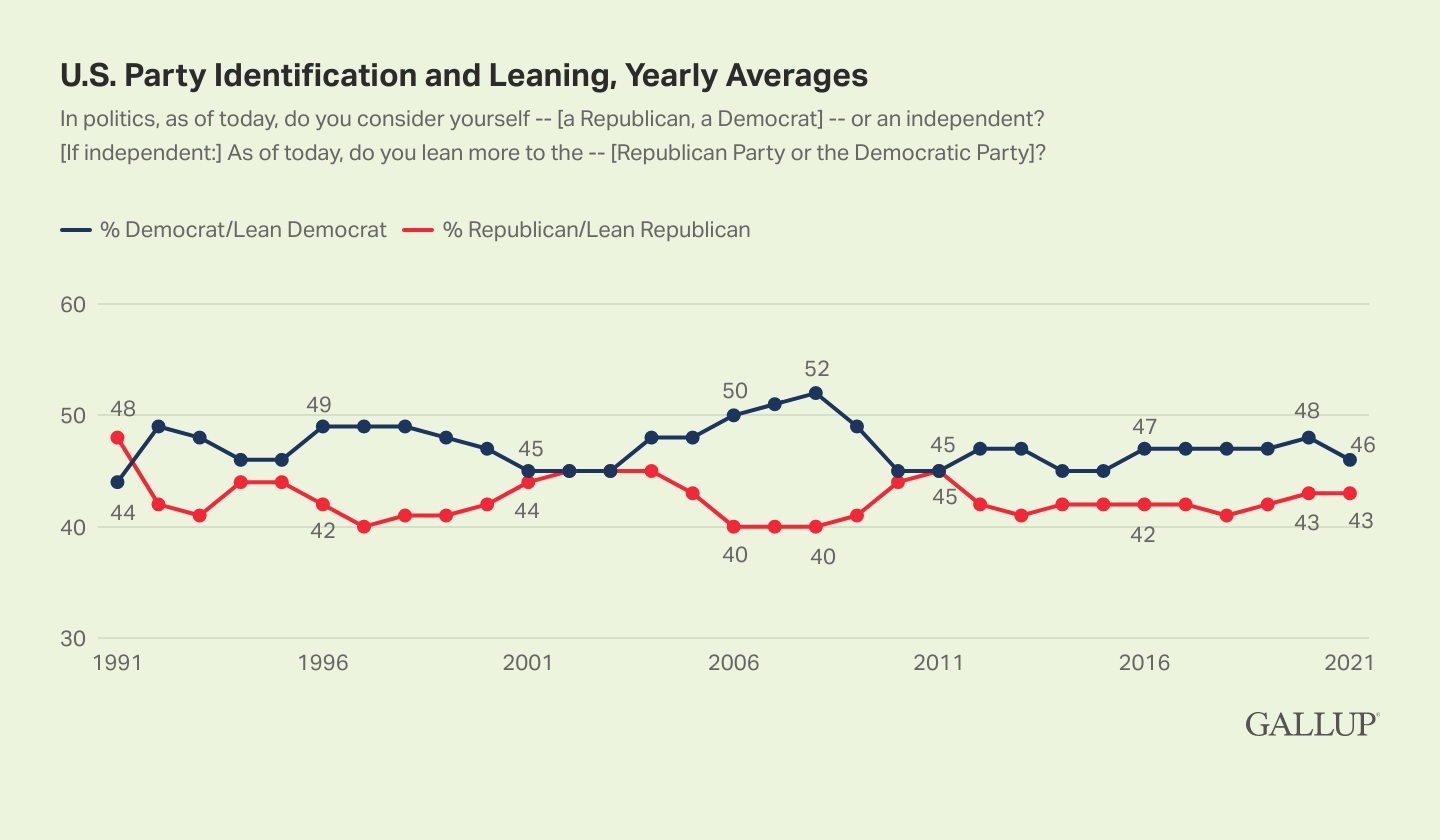
Line graph. Yearly averages of U.S. party identification and leaning betwixt 1991 and 2021. In nigh years, more Americans take identified equally Democrats or leaned Autonomous than have identified equally Republican or leaned Republican. Republicans had an advantage only in 1991, 48% to 44%. Democrats' largest advantage was in 2008, 52% to 40%.
Independents Are Still the Largest Political Group in the U.Due south.
Regardless of which party has an reward in political party affiliation, over the by three decades, presidential elections have by and large been competitive, and party control of the U.S. Business firm of Representatives and Senate has changed hands numerous times. This is partly because neither party can claim a very high share of core supporters -- those who identify with the party -- as the largest proportion of Americans identify initially as political independents.
Overall in 2021, an boilerplate of 29% of Americans identified as Democrats, 27% as Republicans and 42% as independents. Roughly equal proportions of independents leaned to the Autonomous Party (17%) and to the Republican Political party (16%).
The percentage of independent identifiers is up from 39% in 2020, but like to the 41% measured in 2019. Gallup has ofttimes seen a decrease in independents in a presidential election year and an increase in the year after.
The broader trend toward an increasing share of political independents has been clear over the past decade, with more Americans viewing themselves every bit independents than did and then in the belatedly 1980s through 2000s. At to the lowest degree four in 10 Americans accept considered themselves independents in all years since 2011, except for the 2016 and 2020 presidential ballot years. Earlier 2011, independent identification had never reached 40%.
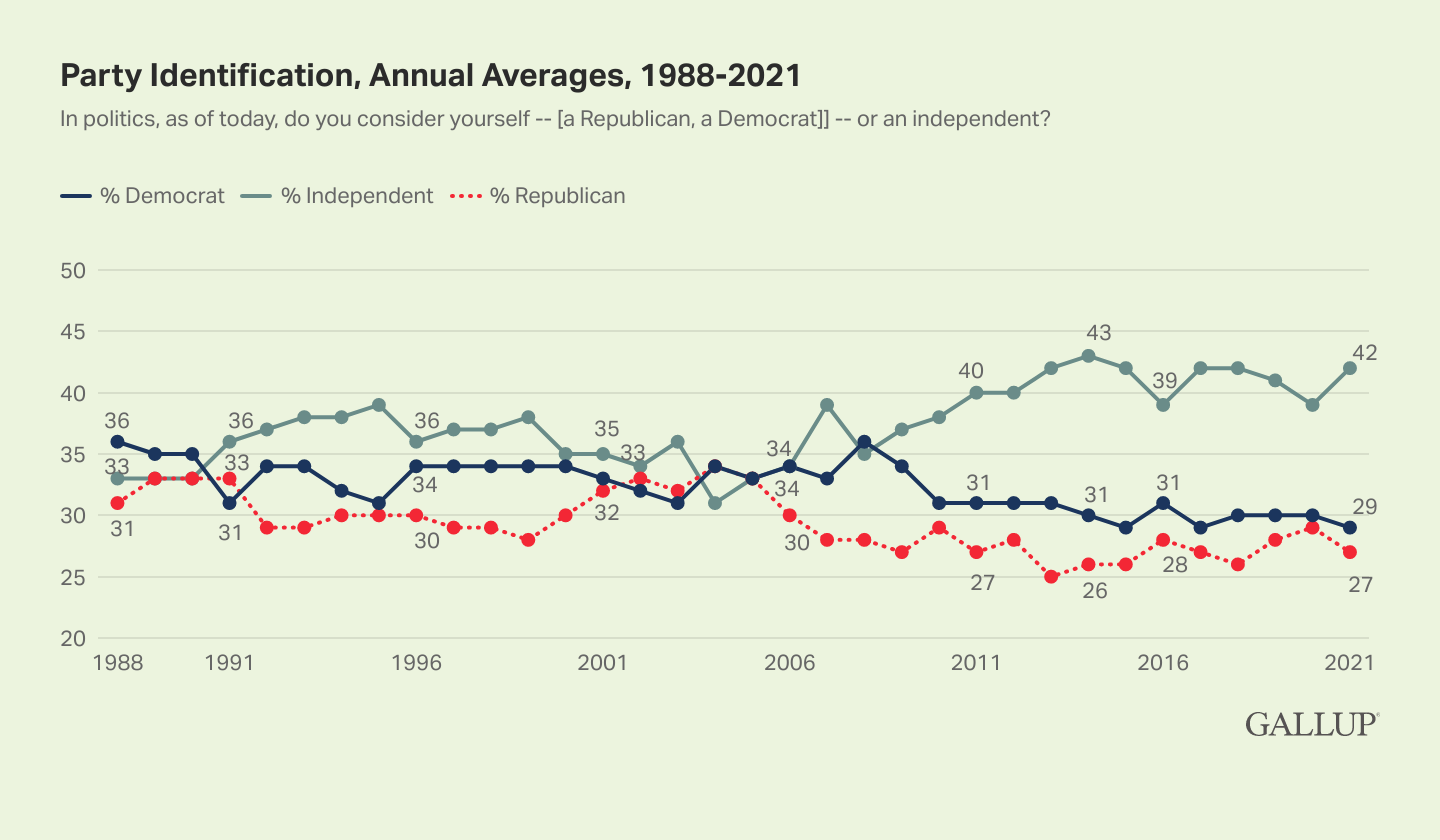
Line graph. Almanac averages in party identification, 1988 through 2021. Since 1998, more than Americans have typically identified every bit Democrats than every bit Republicans. Over the past decade, independents have significantly outnumbered supporters of either party.
Bottom Line
The year 2021 was an eventful one in politics, after a similarly eventful 2020 that also saw major shifts in party preferences. In early 2021, Democratic strength reached levels not seen in nearly a decade. By the 3rd quarter, those Democratic gains evaporated as Biden's job approving declined. The political winds continued to become more favorable to Republicans in the fourth quarter, giving the GOP an advantage over Democrats larger than whatsoever they had achieved in more than than 25 years.
The final monthly survey of 2021 showed the parties at roughly even strength, although that still represents a departure from the historical norm of the Autonomous Party's having at least a slight advantage in party amalgamation.
With control of the Firm of Representatives and Senate at stake in this yr'due south midterm elections, party preferences will be a key indicator of which political party will be better positioned to proceeds majorities in the adjacent session of Congress.
To stay upward to date with the latest Gallup News insights and updates, follow us on Twitter .
Learn more than about how the Gallup Poll Social Serial works.

What Percentage Of Americans Are Registered As Indepedent,
Source: https://news.gallup.com/poll/388781/political-party-preferences-shifted-greatly-during-2021.aspx
Posted by: osbornesteaking.blogspot.com
0 Response to "What Percentage Of Americans Are Registered As Indepedent"
Post a Comment